
Fact check: McDonald's is the most cancer-causing burger chain in the United States due to the highest combination of processed ing…
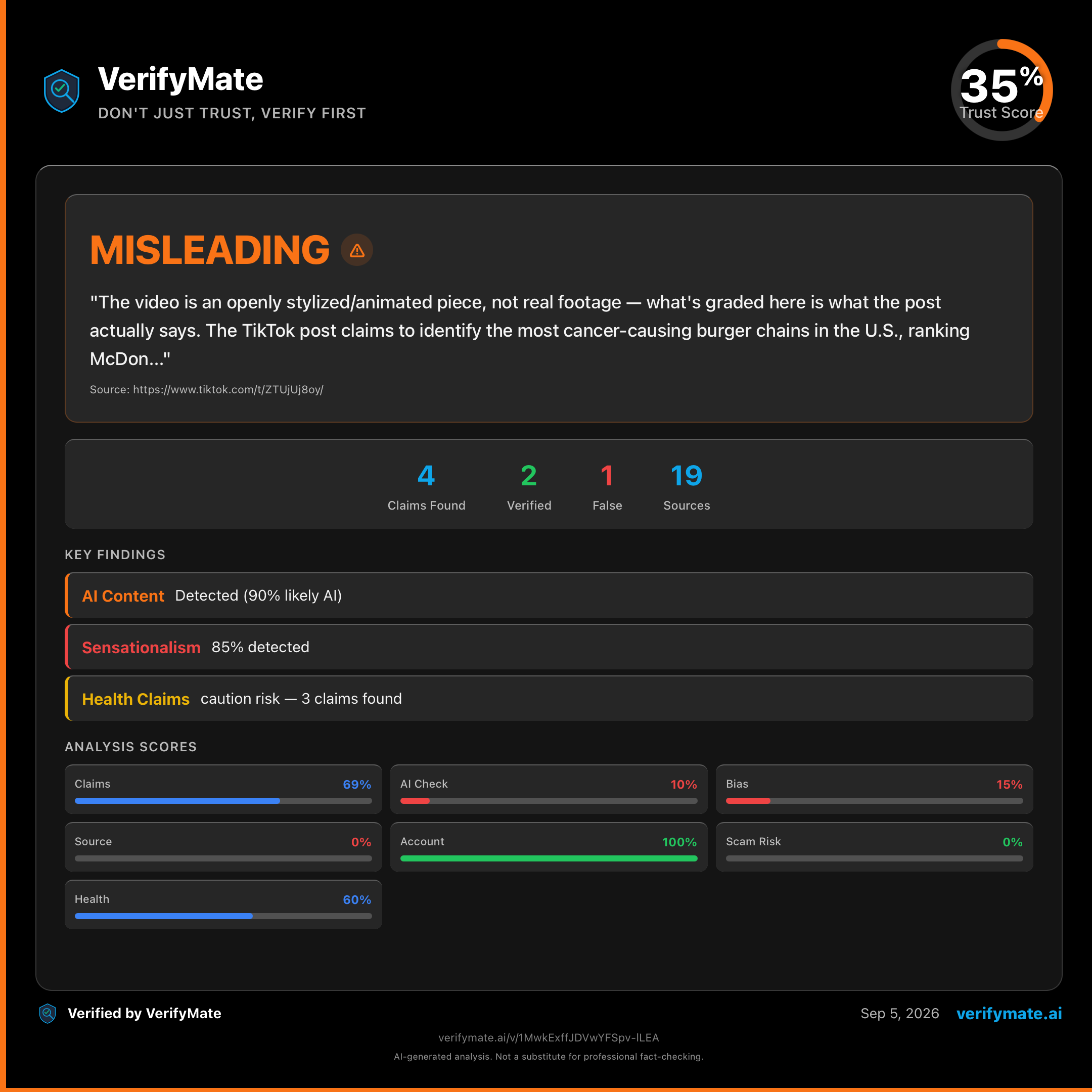
Verdict: misleading — Trust Score 35/100
The video is an openly stylized/animated piece, not real footage — what's graded here is what the post actually says. The TikTok post claims to identify the most cancer-causing burger chains in the U.S., ranking McDonald's as number one and suggesting In-N-Out as a cleaner option. While some ingredients commonly found in fast food, such as processed meats, artificial colors, and certain cooking byproducts, have been linked to potential health risks including cancer, the post makes definitive and exaggerated claims without sufficient scientific evidence to support a ranking of specific chains as "most cancer-causing." The World Health Organization classifies processed meat as a Group 1 carcinogen, and studies have linked various food additives and chemicals to health concerns, but the post's presentation is highly sensationalized and lacks nuanced scientific context.
- Platform
- tiktok
- Source author
- usa.top.list — see all fact-checks of this account
- Original post
- https://www.tiktok.com/t/ZTUjUj8oy/
- Verified on
- September 5, 2026
- Verification ID
- 1MwkExffJDVwYFSpv-lLEA
Original content reviewed
Platform: TIKTOK Author: @usa.top.list --- Caption/Description --- Do you know??? #usa#cancer#causing#chains#burger --- Audio Transcript (What was said) --- Which is the most cancer causing burger chain in the United States? Most Americans might know that the cleaner burger chain in the U S C. Is in N out Burger. So. Which is the most cancer causing burger chain in the United States? Fifth place Sonic Drive. In, sonic relies on heavily processed patties, high heat cooking methods, and additives that have raised long term concerns about heterocyclic amines and potential cancer risk. Fourth place Jack in the box. Jack in the box is loaded with processed beef, charred cooking byproducts, and industrial additives that researchers have flagged for possible DNA damage and elevated cancer risk markers. Third place Wendy's. Wendy's uses significant amounts of processed meat, high temperature grilling, and chemical preservatives associated with chronic inflammation and increased cancer risk indicators. In the second place, Whataburger. Whataburger combines high volumes of processed beef, high heat cooking toxins, and additives that have triggered repeated safety debates about long term cancer risks. Before announcing the first place comment in the section below the chain you think is the most cancer causing in the United States, the chain ranks first is widely regarded as the most cancer causing burger chain due to the highest combination of processed meat volume, high heat cooking byproducts, and chemical additives linked to the strongest consumer and research concerns. That's McDonald's. --- On-Screen Text (OCR) --- DANGEROUS INGREDIENTS IN BURGERS PRESERVATIVES (SODIUM NITRITE) ARTIFICIAL COLORS (FD&C) FLAVOR ENHANCERS (MSG) HARMFUL FATS (TRANS FAT) ACRYLAMIDE HETEROCYCLIC AMINES (HCAS) ADVANCED GLYCATION END PRODUCTS (AGES) OXIDE (TBHQ) LATES S D COMPOUNDS DUES THE MOST CANCER-CAUSING BURGER CHAINS MOST AMERICANS MIGHT © 2020 Microsoft Corporation / Earthstar Geograp
Claims analyzed (4)
- misleading: McDonald's is the most cancer-causing burger chain in the United States due to the highest combination of processed ingredients.
While McDonald's, like other fast-food chains, uses processed ingredients and some chemicals linked to health concerns, there is no definitive scientific consensus or authoritative ranking that labels it as the 'most cancer-causing burger chain in the United States.' The World Health Organization (WHO) has classified processed meat as a Group 1 carcinogen, meaning there is sufficient evidence that it can cause cancer. Studies have also found phthalates, chemicals used to make plastic more durabl - mostly true: In-N-Out Burger is a cleaner option compared to other burger chains.
In-N-Out Burger has made efforts to remove artificial ingredients from its menu. In 2025, the company announced it was removing artificial colors like Red 40 and Yellow 5 from its strawberry shakes and pink lemonade, replacing them with natural sources. They also transitioned to using real sugar instead of high-fructose corn syrup in ketchup and sauces. In-N-Out states that its hamburger patties are made from 100% American beef, never frozen, and fresh produce is prepared daily. These actions al - unverifiable: The list of most cancer-causing chains includes Sonic Drive-In (5th), Jack in the Box (4th), Wendy's (3rd), Whataburger (2nd), and McDonald's (1st).
There is no widely recognized scientific or health organization that publishes a definitive ranking of fast-food burger chains based on their "cancer-causing" potential. While individual ingredients used by these chains may have documented health concerns, a comprehensive, comparative ranking like the one presented in the video is not supported by current scientific literature. Some sources discuss general concerns about processed foods and certain additives in fast food, but do not provide such - mostly true: Dangerous Ingredients in Burgers include Preservatives (Sodium Nitrite), Artificial Colors (FD&C), Flavor Enhancers (MSG), Harmful Fats (Trans Fat), Acrylamide, Heterocyclic Amines (HCAs), Advanced Glycation End Products (AGEs), TBHQ, and Phthalates.
Many of the listed ingredients have been identified by health organizations and scientific studies as having potential health risks, including links to cancer. Sodium nitrite, commonly found in processed meats, can form harmful nitrosamines and has been linked to an increased risk of certain cancers. Artificial food colorings have been associated with hyperactivity in children and some concerns about cancer. Trans fats are known to increase the risk of heart disease and type 2 diabetes. Acrylami
Sources consulted (19)
- harvard.edu — harvard.edu
- healthline.com — healthline.com
- osu.edu — osu.edu
- newsweek.com — newsweek.com
- center4functionalmedicine.com — center4functionalmedicine.com
- chefsforseniors.com — chefsforseniors.com
- cleanwater.org — cleanwater.org
- Consumer Alert: New McDonald's McValue Menu Items Could Take a Toll on Your Health, Warns Doctors Group — Physicians Committee for Responsible Medicine
- ewg.org — ewg.org
- facebook.com — facebook.com
- flamepizza.co.nz — flamepizza.co.nz
- foodingredientsfirst.com — foodingredientsfirst.com
- hudsonvalleypost.com — hudsonvalleypost.com
- in-n-out.com — in-n-out.com
- pcrm.org — pcrm.org
- sciencedaily.com — sciencedaily.com
- skoutorganic.com — skoutorganic.com
- sonicdrivein.com — sonicdrivein.com
- youtube.com — youtube.com
Related verifications
- The world map is actually much larger than commonly depicted, with hidden landmasses beyo… — False 15/100tiktok · view post ↗
The post presents several claims about a world map being larger than commonly depicted, with hidden landmasses and advanced civilizations beyond an Antarctic ice wall. These claims are central to the …
- Erika Kirk has officially moved on from Charlie Kirk less than a year later. — False 25/100tiktok · view post ↗
The post claims Erika Kirk has officially moved on from Charlie Kirk less than a year after his death. However, Erika Kirk publicly denied dating rumors in May 2026, approximately eight months after C…
- Scientists claim they found Noah's Ark in Turkey and now researchers are digging for answ… — Mostly true 75/100tiktok · view post ↗
The post accurately states that researchers are actively investigating a boat-shaped structure near Mount Ararat in Turkey, with drilling and excavation commencing in 2026. However, the claim that Noa…
- Black mirrors were used to contact spirits. — Misleading 25/100tiktok · view post ↗
The post makes several claims about hidden rituals and the power of words, but VerifyMate's analysis found most of these claims to be either false or unverifiable. While black mirrors have a historica…
- The speaker asks if someone would be okay with dating conjoined twins and sharing them. — Misleading 35/100instagram · view post ↗
The post features two individuals presented as conjoined twins asking a question about dating and sharing them. VerifyMate's analysis, supported by 8 sources, indicates that these individuals are AI-g…
AI-generated analysis. Not a substitute for professional fact-checking.