
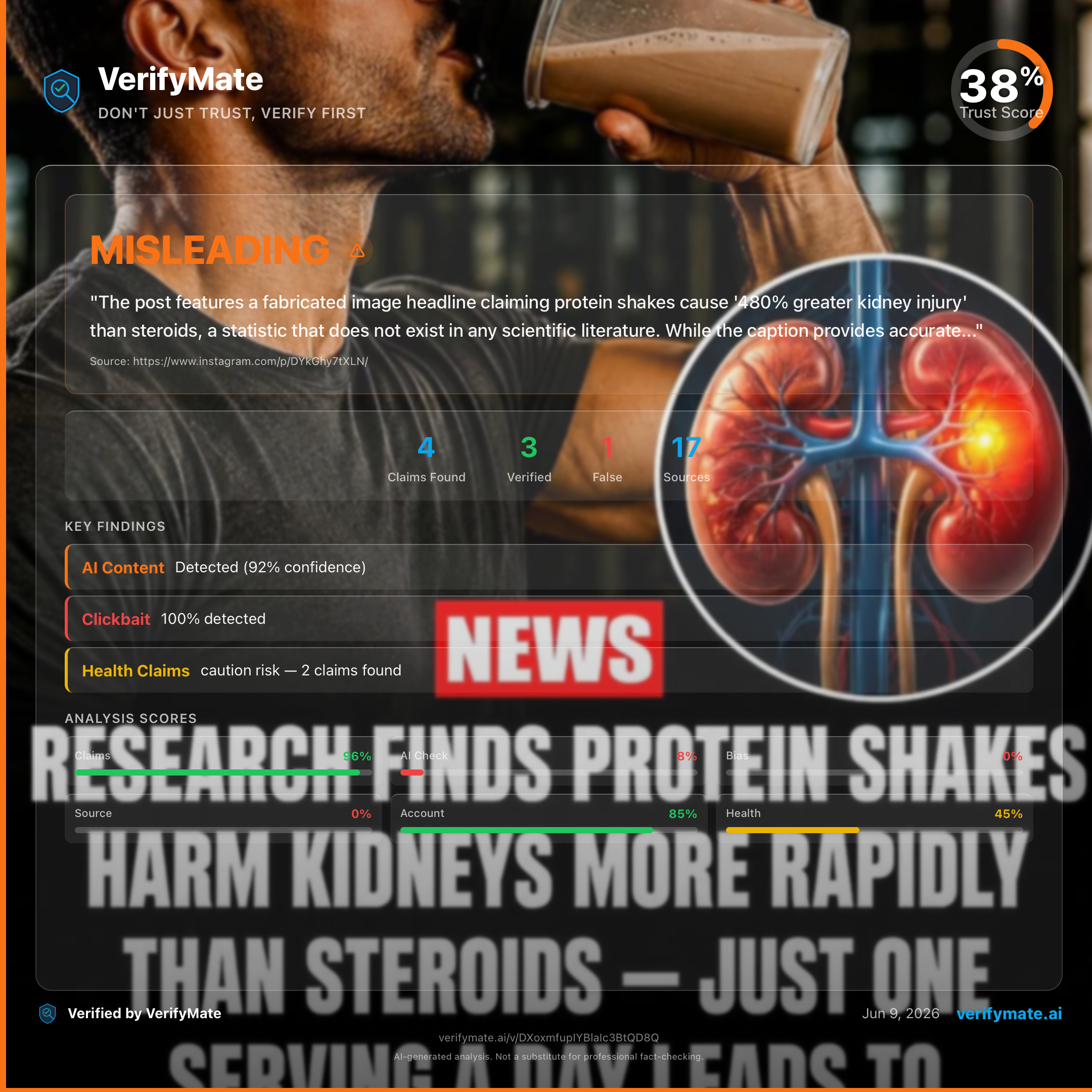
Fact check: Research finds protein shakes harm kidneys more rapidly than steroids, with one serving a day leading to 480% greater k…
Verdict: misleading — Trust Score 38/100
The post features a fabricated image headline claiming protein shakes cause '480% greater kidney injury' than steroids, a statistic that does not exist in any scientific literature. While the caption provides accurate health advice regarding protein metabolism and hydration corroborated by refuted by 7 sources, the primary visual hook is a sensationalist fabrication designed to alarm users.
- Platform
- Source author
- peopleafteranesthesia — see all fact-checks of this account
- Original post
- https://www.instagram.com/p/DYkGhy7tXLN/
- Verified on
- June 10, 2026
- Verification ID
- DXoxmfupIYBlaIc3BtQD8Q
Original content reviewed
Platform: INSTAGRAM Author: @peopleafteranesthesia --- Caption/Description --- The Protein Perspective: Kidney Health & Supplementation 🥤⚖️ Are your post-workout shakes doing more harm than good to your internal filtration system? Let’s look at what nephrology and nutritional science suggest: Here’s how it may help: • Processing Load: For those with healthy kidneys, high protein intake is generally well-tolerated, but it does require the kidneys to work harder to filter nitrogen byproducts. • Hydration Importance: High protein consumption increases the need for water; staying hydrated is the best way to support your kidneys during supplementation. • Quality Matters: Choosing clean, third-party tested protein powders helps you avoid heavy metals or “fillers” that can strain your system. • Balance is Key: While extreme excess can be taxing, moderate protein intake is a vital building block for muscle repair and metabolic health. It’s a reminder to listen to your body, stay hydrated, and prioritize whole-food protein sources whenever possible. ✨ Supplement wisely. Support your kidneys. Share this with your gym partner to keep the conversation going! 💫 Published: 2026-05-20T14:37:54.000Z ---VERIFICATION_SUMMARY--- Platform: INSTAGRAM Author: @peopleafteranesthesia --- Caption/Description --- The Protein Perspective: Kidney Health & Supplementation 🥤⚖️ Are your post-workout shakes doing more harm than good to your internal filtration system? Let’s look at what nephrology and nutritional science suggest: Here’s how it may help: • Processing Load: For those with healthy kidneys, high protein intake is generally well-tolerated, but it does require the kidneys to work harder to filter nitrogen byproducts. • Hydration Importance: High protein consumption increases the need for water; staying hydrated is the best way to support your kidneys during supplementation. • Quality Matters: Choosing clean, third-party tested protein powders helps you avoid heavy metals or “fille
Claims analyzed (4)
- false: Research finds protein shakes harm kidneys more rapidly than steroids, with one serving a day leading to 480% greater kidney injury.
There is no scientific study supporting a '480% greater kidney injury' from protein shakes compared to steroids. Steroids are clinically recognized as nephrotoxic, while protein is a standard macronutrient that is safe for healthy kidneys. - verified: High protein intake requires kidneys to work harder to filter nitrogen byproducts.
Protein metabolism produces urea and nitrogenous waste, which the kidneys must filter. This increases the glomerular filtration rate (GFR), often described as the kidneys 'working harder.' - verified: Third-party tested protein powders help consumers avoid heavy metals like lead and cadmium.
Independent testing by the Clean Label Project and Consumer Reports has found significant levels of lead, cadmium, and arsenic in many popular protein powders, particularly plant-based ones. - verified: For individuals with healthy kidneys, high protein intake is generally well-tolerated.
Multiple meta-analyses and position stands from sports nutrition organizations confirm that high protein intake (up to 2.2g/kg or higher) does not adversely affect renal function in healthy adults.
Sources consulted (17)
- mcmaster.ca — mcmaster.ca
- eurekalert.org — eurekalert.org
- nih.gov — nih.gov
- clevelandclinic.org — clevelandclinic.org
- wellbeingnutrition.com — wellbeingnutrition.com
- cleanlabelproject.org — cleanlabelproject.org
- wfaa.com — wfaa.com
- Myth busted: Researchers show that a high-protein diet does not affect kidney function — ScienceDaily / McMaster University
- Is Protein Bad for Your Kidneys? — Cleveland Clinic
- The effects of increased protein intake on kidney size and function — PubMed / NIH
- Impact of Whey Protein on Kidneys — NU Hospitals
- Attorney General Ken Paxton Launches Industry-Wide Investigation into Protein Powder Manufacturers — Texas Attorney General
- Nearly Half of Top-Selling Protein Powders Exceed Safety Thresholds for Heavy Metal Contamination — Clean Label Project
- International Society of Sports Nutrition Position Stand: protein and exercise — JISSN
- Does eating more protein increase the risk of chronic kidney disease? — Examine.com
- Anabolic steroid use and the kidney — PubMed / NIH
- The hidden dangers of protein powders — Harvard Health Publishing
Related verifications
- The speaker asks if someone would be okay with dating conjoined twins and sharing them. — Misleading 35/100instagram · view post ↗
The post features two individuals presented as conjoined twins asking a question about dating and sharing them. VerifyMate's analysis, supported by 8 sources, indicates that these individuals are AI-g…
- Nicki Minaj has reportedly been named Trump's next White House Press Secretary. — False 10/100instagram · view post ↗
The claim that Nicki Minaj has been named Trump's next White House Press Secretary is false. This rumor has circulated on social media and has been debunked by 4 sources, including Reel 360 News and H…
- AI-generated — ByteDance Seedance 2.5. The generator's own Content Credentials declare th… — Misleading 3/100upload
AI-generated — ByteDance Seedance 2.5. The generator's own Content Credentials declare this AI-generated. The signature and content binding check out; the signer isn't on the official C2PA trust list …
- This is an AI-generated synthetic profile of Simon Geng Zurup Tharyiep. The Facebook plat… — False 15/100facebook · view post ↗
This is an AI-generated synthetic profile of Simon Geng Zurup Tharyiep. The Facebook platform itself has labeled some of the account's posts as 'AI content,' indicating the use of artificial intellige…
- Michael B. Jordan reportedly said about his past relationship with Lori Harvey: "My relat… — Misleading 25/100instagram · view post ↗
The post attributes a quote to Michael B. Jordan about his past relationship with Lori Harvey, claiming she demanded a $50K weekly allowance. However, this quote is unconfirmed and not corroborated by…
AI-generated analysis. Not a substitute for professional fact-checking.