
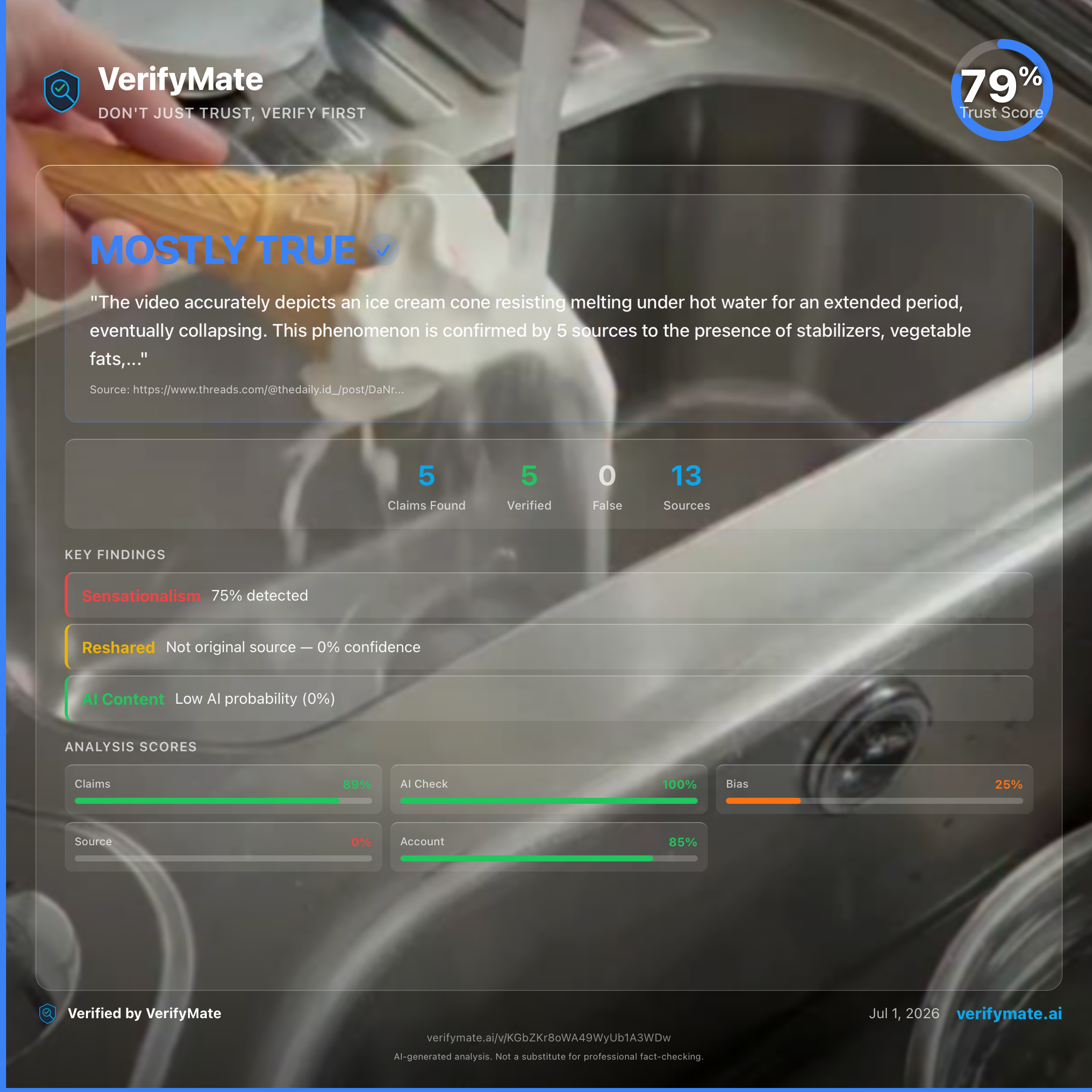
Fact check: A video shows an ice cream cone being held under steaming hot water for nearly a full minute.
Verdict: mostly true — Trust Score 79/100
The video accurately depicts an ice cream cone resisting melting under hot water for an extended period, eventually collapsing. This phenomenon is confirmed by 5 sources to the presence of stabilizers, vegetable fats, emulsifiers, and increased air content in modern commercial ice creams, often labeled as "frozen dairy desserts." These ingredients are intentionally designed to improve texture, shelf life, and melt resistance.
- Platform
- threads
- Source author
- thedaily.id_ — see all fact-checks of this account
- Original post
- https://www.threads.com/@thedaily.id_/post/DaNrRXCEl-z?xmt=AQG0DGmRxQ97hNIQZnXCbhosCJmY3JrFhtPOlXEei--sCfJZNvw3NFuB36qkgAI3a-14dAob
- Verified on
- July 1, 2026
- Verification ID
- KGbZKr8oWA49WyUb1A3WDw
Original content reviewed
Platform: THREADS Author: @thedaily.id_ --- Caption/Description --- A viral video is raising eyebrows after showing an ice cream cone held under steaming hot water for nearly a full minute before it finally collapsed and washed away. Many viewers believe modern commercial ice creams melt differently because they’re made with stabilizers, vegetable fats, emulsifiers, and other ingredients designed to improve texture and shelf life. #IceCream #Food #Viral #ProcessedFood ---VERIFICATION_SUMMARY--- Platform: THREADS Author: @thedaily.id_ Person shown on screen (from video analysis): A person's hand is visible holding an ice cream cone under running water. What the video shows (from video analysis): The video shows a person holding an ice cream cone under a running faucet in a kitchen sink. The ice cream is white with some pink sprinkles and is slowly melting under the hot water, creating steam. The video then transitions to a screen displaying text about why modern ice cream resists melting, explaining that it's often labeled as "frozen dairy dessert" and contains stabilizers, gums, vegetable oils, and more air, all engineered to prevent it from melting quickly. --- HOW TO VERIFY THIS (provenance-first) --- 1. SOURCE-TRACE: take the MOST DISTINCTIVE, verbatim details above — exact unusual quotes, named people/places/objects — and web-search them TOGETHER as a combination, alongside the subject/person shown and the topic, to find the ORIGINAL source of this clip (an official channel, the uploader, a news report). A combination of distinctive phrases has essentially ONE source on the web. 2. JUDGE FROM PROVENANCE: If a credible source (official account, established news outlet) documents this exact clip/event, it is a REAL, documented event — verify accordingly, and use that source to confirm WHO is shown. If after searching NO credible source corroborates an extraordinary or specific claim, state it CANNOT BE VERIFIED (and for a sensational claim lean toward not-cre
Claims analyzed (5)
- verified: A video shows an ice cream cone being held under steaming hot water for nearly a full minute.
The video content provided in the user submission clearly shows a person holding an ice cream cone under steaming hot water. Multiple news reports and viral video analyses confirm the existence and content of such a video, noting its duration of nearly a minute before significant melting. - mostly true: The ice cream cone eventually collapsed and washed away after being exposed to hot water.
The video analysis provided in the user content states that the ice cream slowly melted and collapsed. News reports discussing the viral video also confirm that the ice cream eventually melted and washed away after prolonged exposure to hot water. - verified: Many viewers believe modern commercial ice creams melt differently due to ingredients like stabilizers, vegetable fats, and emulsifiers.
The caption explicitly states this belief among viewers. News articles discussing the viral video also confirm that viewers speculated about these ingredients as the reason for the ice cream's melting behavior. - verified: These ingredients are designed to improve the texture and shelf life of ice cream.
Stabilizers and emulsifiers are commonly used in commercial ice cream to improve texture, prevent ice crystal formation, enhance creaminess, and extend shelf life by improving resistance to melting and temperature fluctuations. - verified: Modern ice cream is often labeled as "frozen dairy dessert" and contains stabilizers, gums, vegetable oils, and more air, all engineered to prevent it from melting quickly.
The video's on-screen text and audio transcript state this. The FDA defines "ice cream" with specific criteria for milk fat and weight. Products that do not meet these standards are often labeled "frozen dairy dessert." These products frequently use stabilizers, gums, vegetable oils, and increased air (overrun) to achieve desired texture, stability, and melt resistance, often as cost-cutting measures.
Sources consulted (13)
- Ice Cream Standard | Agricultural Marketing Service - USDA — USDA
- Ice Cream Cone Under Steaming Hot Water Didn't Melt - The Daily Dot — The Daily Dot
- Food Safety of Ice Cream Stabilizers and Emulsifiers - The ANSI Blog — The ANSI Blog
- How Stabiliser and Emulsifier Systems Improve Ice Cream Texture, Stability, and Melting Resistance - DKSH Discover — DKSH Discover
- Ice Cream Trends 2026: GLP-1, Clean Labels, Less Sugar - Food - GreyB — GreyB
- 9 Ice Cream Brands That Aren't Ice Cream — And 3 That Actually Are - YouTube — YouTube
- futuremarketinsights.com — futuremarketinsights.com
- greyb.com — greyb.com
- ingreland.com — ingreland.com
- qyresearch.com — qyresearch.com
- Viral X Video Claims Ice Cream Won't Melt Here's What You Need to Know - YouTube — YouTube
- Why Are Stabilizers Used in Ice Cream? The Secret to Creamy, Smooth Texture - Creamarie — Creamarie
- youtube.com — youtube.com
Related verifications
- Hundreds of Thousands of Prominent Trump Allies Reported Missing After Ukrainian Strike o… — Mixed 59/100threads · view post ↗
The post is a satirical piece that humorously links recent Ukrainian drone strikes on Russian Yandex data centers to the fictional disappearance of 'Trump allies.' While multiple sources confirm that …
- Hundreds of Thousands of Prominent Trump Allies Reported Missing After Ukrainian Strike o… — Mixed 50/100threads · view post ↗
Openly AI-made image — graded on what the post actually says. The post is a satirical take on recent events, but it is based on the factual premise that Ukrainian drone strikes have targeted Russian Y…
- ICE LAUNCHES OPERATION SAFE CALIFORNIA — Mixed 50/100threads · view post ↗
The post accurately reports on the recent launch of 'Operation Safe California' by ICE in October 2026, which is expected to last 45 days and has drawn responses from California officials. This is con…
- ICE LAUNCHES OPERATION SAFE CALIFORNIA — Misleading 25/100threads · view post ↗
The post claims ICE launched "Operation Safe California" in California, which is largely corroborated by 4 sources, including the Washington Examiner and The New Republic. However, the post misreprese…
- JD Vance said, "If I have to make up stories, that’s what I’m going to do." — Mixed 59/100threads · view post ↗
The post contains a mix of accurate and unverified information. It accurately attributes several statements to J. D. Vance about his views on socialism and American workers, which are corroborated by …
AI-generated analysis. Not a substitute for professional fact-checking.