
Fact check: This post was made by @b09golf on Threads.
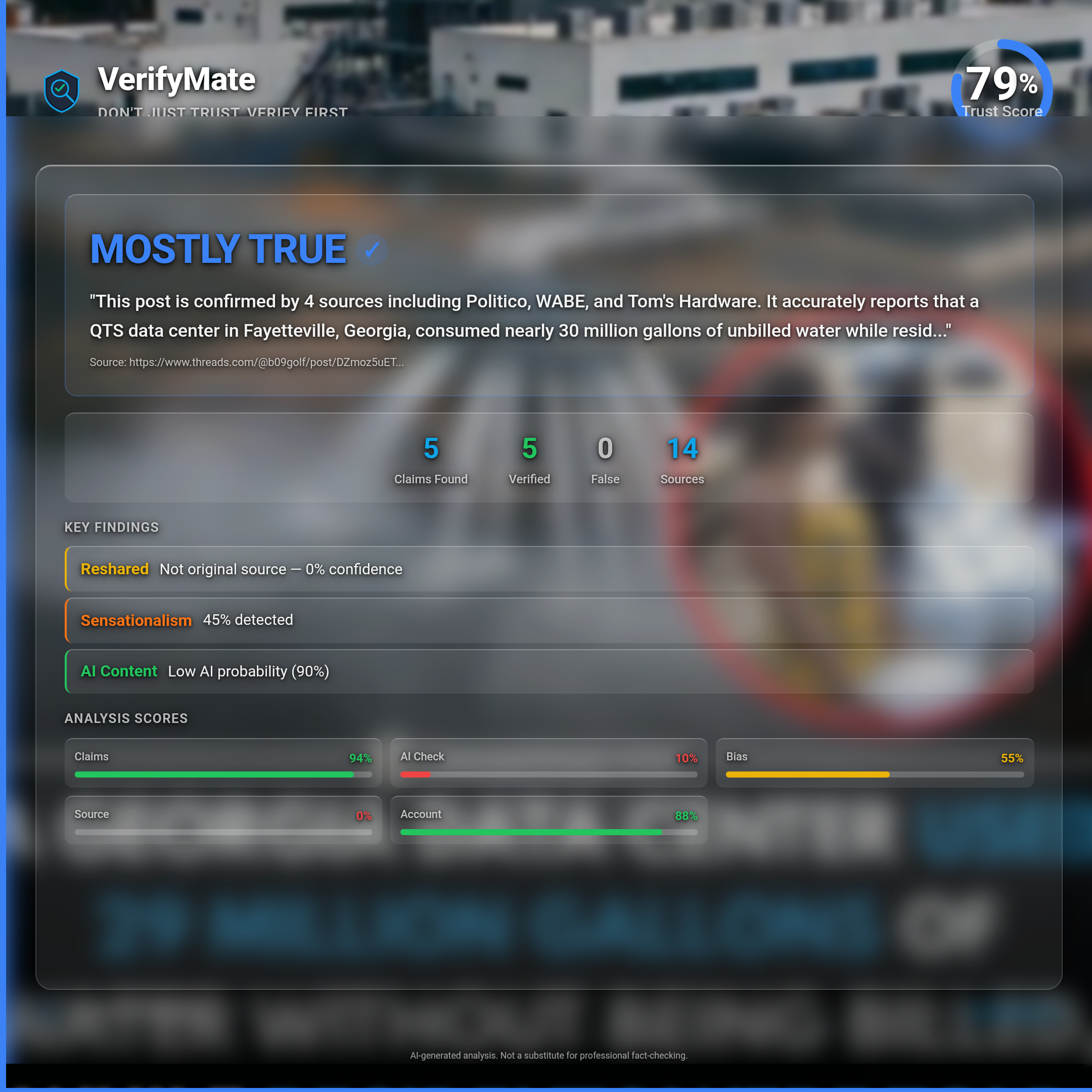
Verdict: mostly true — Trust Score 79/100
This post is confirmed by 4 sources including Politico, WABE, and Tom's Hardware. It accurately reports that a QTS data center in Fayetteville, Georgia, consumed nearly 30 million gallons of unbilled water while residents faced conservation orders. However, it frames a documented utility billing error as a 'delayed billing arrangement,' which implies an intentional deal not supported by official reports.
- Platform
- threads
- Source author
- b09golf — see all fact-checks of this account
- Original post
- https://www.threads.com/@b09golf/post/DZmoz5uET-F?xmt=AQG0tq8IVfs2wk-dhAlXC4v5J8J5Yb0py6AVW-mEzRYiJwuggcPxzLoQyUtGgAYVVTFaOUc&slof=1
- Verified on
- June 15, 2026
- Verification ID
- W1_KFtK2LXXrI7MvPZJQGg
Original content reviewed
Platform: THREADS Author: @b09golf --- Caption/Description --- AI Runs on Data, But Data Centers Run on Water. Large data centers are becoming a major resource challenge as artificial intelligence and cloud computing continue to expand. These facilities use powerful servers that generate enormous heat, and many rely on water-based cooling systems to keep equipment operating safely. In places like Georgia, reports have raised concerns about transparency, utility agreements, and the environmental impact of rapidly growing AI infrastructure. Some municipalities offer special industrial deals or delayed billing arrangements to attract major technology investments, but controversy grows when residents are asked to conserve water while large facilities continue expanding. Data centers can bring jobs, investment, and digital infrastructure, but they also place pressure on local water systems, especially during droughts, population growth, or periods of extreme heat. Communities are increasingly asking whether the benefits of these projects outweigh the costs to local resources. Technology companies are now exploring recycled water, seawater cooling, liquid cooling, and other alternatives to reduce environmental impact. The future of AI will depend not only on faster chips and smarter models, but also on responsible water and energy management. The debate shows a simple truth: digital progress is not invisible. It depends on real land, real electricity, and real water. #DataCenters #ArtificialIntelligence #WaterUsage #AIInfrastructure #CloudComputing #SustainableTech #Georgia #ResourceManagement #GreenComputing --- On-Screen Text (OCR) --- EP ENGINEERING POST A GEORGIA DATA CENTER USED 29 MILLION GALLONS OF WATER WITHOUT BEING BILLED, WHILE RESIDENTS WERE TOLD TO CONSERVE ---VERIFICATION_SUMMARY--- Platform: THREADS Author: @b09golf --- Caption/Description --- AI Runs on Data, But Data Centers Run on Water. Large data centers are becoming a major resource challen
Claims analyzed (5)
- verified: This post was made by @b09golf on Threads.
The content is authentic to the @b09golf account on Threads as provided in the source URL. - verified: A Georgia data center used 29 million gallons of water without being billed.
Public records and investigative reporting from May and June 2026 confirm that the QTS Fayetteville data center (Project Excalibur) used approximately 29.5 million gallons of water that went unbilled until residents complained of low pressure. - verified: Residents in Georgia were instructed to conserve water while local data centers continued to expand.
Residents in Fayetteville were instructed to conserve water due to drought conditions and low pressure during the same period the QTS data center was consuming unbilled resources. - mostly true: Some Georgia municipalities offer special industrial deals or delayed billing arrangements to attract technology investments.
While Georgia municipalities offer significant tax incentives and abatements, the specific 'delayed billing' in the QTS case was identified by officials as a procedural error, not a pre-arranged deal. - verified: Large data centers rely on water-based cooling systems to manage heat generated by AI and cloud computing servers.
Water-based cooling is a standard industry practice for managing the high thermal loads of modern AI and cloud servers.
Sources consulted (14)
- politicopro.com — politicopro.com
- wabe.org — wabe.org
- thecooldown.com — thecooldown.com
- itea.org — itea.org
- Post by @b09golf on Threads — Threads
- AI data center project secretly sucked 29 million gallons of water over 15 months — Tom's Hardware
- A data center drained 30M gallons of water unnoticed — until residents complained — Politico
- Residents were told to stop watering lawns while massive Georgia data center quietly drained millions — TechRadar
- Data centers face pushback amid utility consumption in south metro Atlanta — WABE
- Georgia Data Center Secretly Guzzled 30 Million Gallons of Water Before Paying a Dime — Gizmodo
- All Georgia data center ordinances — from most to least restrictive — Columbus Ledger-Enquirer
- Understanding How Data Centers Impact Surface and Ground Waters — University of Georgia CAES
- The data center cooling state of play — Tom's Hardware
- Engineering Post Publication Info — Engineering Post
Related verifications
- Hundreds of Thousands of Prominent Trump Allies Reported Missing After Ukrainian Strike o… — Mixed 50/100threads · view post ↗
Openly AI-made image — graded on what the post actually says. The post is a satirical take on recent events, but it is based on the factual premise that Ukrainian drone strikes have targeted Russian Y…
- ICE LAUNCHES OPERATION SAFE CALIFORNIA — Mixed 50/100threads · view post ↗
The post accurately reports on the recent launch of 'Operation Safe California' by ICE in October 2026, which is expected to last 45 days and has drawn responses from California officials. This is con…
- ICE LAUNCHES OPERATION SAFE CALIFORNIA — Misleading 25/100threads · view post ↗
The post claims ICE launched "Operation Safe California" in California, which is largely corroborated by 4 sources, including the Washington Examiner and The New Republic. However, the post misreprese…
- JD Vance said, "If I have to make up stories, that’s what I’m going to do." — Mixed 59/100threads · view post ↗
The post contains a mix of accurate and unverified information. It accurately attributes several statements to J. D. Vance about his views on socialism and American workers, which are corroborated by …
- META SUSPENDS NO KINGS INSTAGRAM ACCOUNT AS 3,000+ PROTESTS ARE SCHEDULED TO TAKE PLACE T… — Verified 90/100instagram · view post ↗
The post accurately reports that Meta temporarily suspended the official No Kings Instagram account on October 17, 2026, as over 3,000 protests were scheduled to take place, and that the account was r…
AI-generated analysis. Not a substitute for professional fact-checking.